Step-by-Step: Launching Your First Online 50/50 Raffle with RaffleGives
Learn how to launch your first 50/50 raffle online in 7 simple steps. RaffleGives makes it easy for non-profits to raise money with fast setup, legal support, and automated prize payouts.
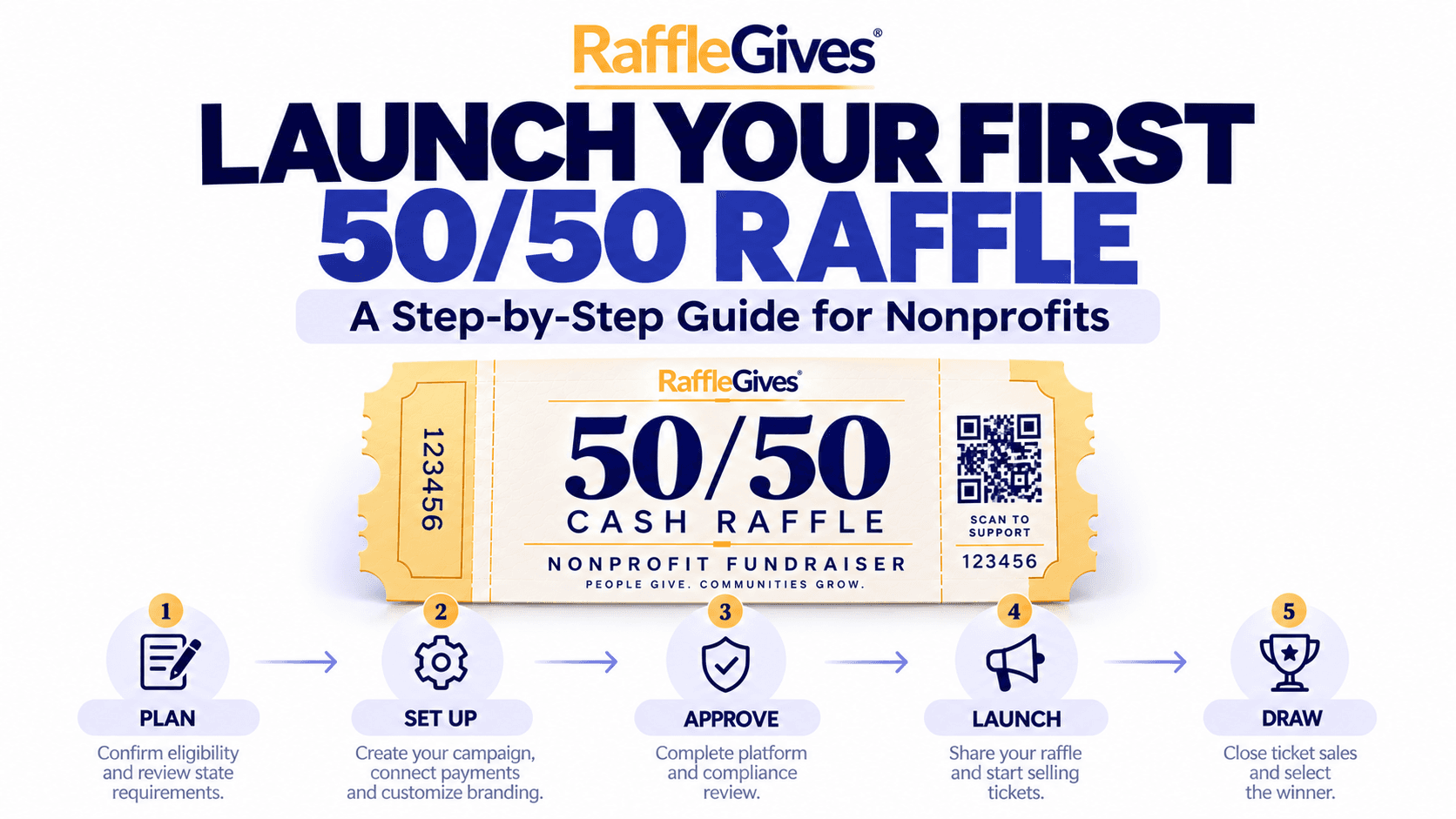
Step-by-Step: Launching Your First Online 50/50 Raffle With RaffleGives
Updated for 2026 | RaffleGives Fundraising Guide
Running a successful 50/50 raffle involves more than choosing a ticket price and announcing a drawing date. Nonprofits need to establish legal eligibility, understand their fundraising economics, configure the campaign correctly, promote it to the right audience and follow the applicable rules when selecting and paying the winner.
Digital raffle technology can make much of that process easier. Instead of managing paper tickets, manually reconciling payments and relying entirely on in-person sales, qualifying organizations can use a purpose-built platform to manage campaign activity in one place.
This guide walks through the process of launching an online 50/50 raffle with RaffleGives, from initial planning through the final drawing and post-campaign reporting. It also explains the legal and operational decisions that nonprofits should resolve before accepting their first ticket purchase.
Quick Answer: How Do You Launch an Online 50/50 Raffle?
To launch an online 50/50 raffle, an eligible nonprofit must first confirm that its state permits the proposed raffle, including online ticket sales, electronic payments and the intended drawing process. The organization then establishes its campaign goals, ticket pricing, prize structure and schedule before configuring its raffle through an appropriate platform.
With RaffleGives, the organization creates an account, completes the required onboarding and verification steps, connects its own Stripe account, builds a branded campaign and submits the raffle for review. Once the necessary approvals are complete, the organization can launch its campaign and begin accepting eligible purchases.
The process can be straightforward, but the legal requirements vary significantly by jurisdiction. A nonprofit's federal tax-exempt status does not automatically authorize it to conduct a raffle or sell tickets online.
What Is a 50/50 Raffle?
A 50/50 raffle is a fundraising arrangement in which the designated prize is generally calculated as 50% of the eligible ticket-sales pool, with the remaining 50% allocated according to the campaign's approved terms and applicable law. Unlike a raffle offering a fixed merchandise prize, the cash prize grows as qualifying ticket sales increase.
For example, a raffle generating $10,000 in gross ticket sales would ordinarily produce a $5,000 winner's prize under a straightforward 50/50 structure. The other $5,000 would represent the nonprofit's portion before any applicable fees, taxes or other permitted expenses.
This structure can be attractive because supporters can see the potential prize increase alongside campaign participation. However, organizations should confirm how their state defines the prize pool, which expenses are permitted and whether the particular 50/50 structure is authorized.
A 50/50 raffle is still a regulated game of chance. The fact that proceeds benefit a nonprofit does not exempt the campaign from charitable gaming laws.
Step 1: Confirm Your Nonprofit Is Eligible to Conduct the Raffle
Before creating a campaign, determine whether your organization qualifies to conduct the proposed raffle under applicable state and local law. A nonprofit may have valid federal tax-exempt status and still be ineligible to conduct certain charitable gaming activities.
Some jurisdictions restrict raffles to specific categories of organizations, require a minimum operating history or impose licensing and registration requirements. Others distinguish between traditional in-person raffles and those involving online ticket purchases, electronic payments or digital drawing systems.
Organizations should confirm five essential questions before proceeding:
- Is our organization eligible to conduct a charitable raffle?
- Are cash prizes and the proposed 50/50 structure permitted?
- Can we sell tickets online and accept electronic payments?
- Where must purchasers be physically located?
- Are our proposed ticketing, drawing and platform arrangements permitted?
These questions should be resolved before the organization begins accepting payments. RaffleGives can provide technology and onboarding support, but the nonprofit remains responsible for obtaining applicable legal authorization.
For additional guidance, read our articles on 501(c)(3) raffle rules, online raffle ticket sales and raffle laws by state.
Step 2: Establish Your Fundraising Goal and Campaign Budget
Once legal eligibility is established, the next step is deciding what the raffle should accomplish financially. A successful campaign begins with a realistic fundraising objective, an understanding of the available audience and a clear explanation of how proceeds will support the organization's mission.
For a first campaign, consider the number of supporters your organization can reasonably reach through email, social media, events, volunteers and community partnerships. An organization with 750 engaged contacts may approach its first raffle differently from a statewide nonprofit with thousands of members and established corporate relationships.
It is also important to distinguish gross ticket sales from the amount ultimately available to the nonprofit. In a conventional 50/50 arrangement, half the ticket-sales pool funds the winner's prize, while platform fees, payment processing and other permitted expenses may reduce the organization's remaining proceeds.
Understanding the Financial Model
RaffleGives charges a standard platform fee of 8% of gross ticket sales, with Stripe payment-processing charges separate. There is no monthly subscription or upfront platform fee.
The following examples illustrate how those costs affect a straightforward 50/50 raffle.
Gross Ticket Sales | Winner's 50% Prize | RaffleGives 8% Fee | Nonprofit Before Processing and Other Expenses |
|---|---|---|---|
$2,500 | $1,250 | $200 | $1,050 |
$5,000 | $2,500 | $400 | $2,100 |
$10,000 | $5,000 | $800 | $4,200 |
$25,000 | $12,500 | $2,000 | $10,500 |
$50,000 | $25,000 | $4,000 | $21,000 |
These examples are illustrative, not revenue forecasts. They assume a 50% prize calculated from gross ticket sales and an 8% platform fee charged against gross sales. Actual net proceeds will depend on payment processing, refunds, taxes, applicable law and other permitted campaign expenses.
Organizations should verify that their jurisdiction permits the proposed allocation of raffle proceeds and expenses. In particular, the amount retained by the nonprofit should never be presented as guaranteed revenue before the campaign closes and all obligations have been reconciled.
Step 3: Choose Your Raffle Dates and Ticket Pricing
A campaign needs a clearly defined beginning and end. The schedule should give supporters enough time to participate while providing a reasonable period for the organization to communicate its message and build momentum.
For many organizations, a campaign lasting several weeks may be easier to promote than one lasting only a few days. However, the appropriate duration depends on the organization's audience, fundraising calendar, promotional capacity and any state restrictions on raffle frequency or duration.
Ticket pricing should be similarly deliberate. A low entry price may encourage broader participation, while higher-priced packages may increase the average transaction value among supporters willing to purchase multiple chances.
For example, a nonprofit might consider a $10 entry option alongside larger ticket packages, provided the pricing structure complies with applicable law. The organization should clearly disclose the number of entries included with each purchase and avoid confusing promotional language.
The objective is not necessarily to maximize the price of an individual ticket. It is to create an accessible participation structure that supports the campaign's financial goals.
Step 4: Create Your RaffleGives Organization Account
With the basic campaign plan established, the nonprofit can begin onboarding through RaffleGives.
The organization creates an account and provides the information necessary for administrative review. This generally includes organizational details, appropriate nonprofit documentation, contact information and any additional materials required for the proposed raffle.
RaffleGives reviews the organization before approving it to proceed. This helps establish that the platform is being used by an appropriate entity, although administrative approval does not replace any government license, registration or authorization the organization must obtain.
The onboarding process is designed to reduce unnecessary complexity. Instead of requiring an organization to purchase software, negotiate a long-term subscription or commission a custom raffle website, RaffleGives provides a dedicated environment for configuring its campaign.
Standard campaigns may be ready in as little as 48 hours after the necessary information is submitted and reviewed. More complex legal, payment or administrative requirements can extend that timeline.
Step 5: Connect Your Organization's Stripe Account
Payment processing is one of the most important parts of digital fundraising. Nonprofits need a clear understanding of how payments are accepted, which account receives the funds and how transaction activity is reconciled.
RaffleGives uses Stripe-connected accounts so participating organizations can connect their own payment-processing infrastructure. This arrangement is intended to keep the nonprofit's financial activity associated with its own account rather than requiring RaffleGives to hold the organization's fundraising proceeds.
During onboarding, the organization completes the applicable Stripe connection and verification steps. Depending on its circumstances, this may involve providing business information, identifying authorized representatives and completing payment-account requirements.
A successful Stripe connection does not independently establish that a particular raffle transaction is lawful or approved under Stripe's policies. Organizations must ensure that the raffle, payment method and processing arrangement are permitted by the relevant authorities and payment provider.
Before launching, the organization should confirm that its payment account is properly configured and that authorized personnel understand how to access transaction records.
Step 6: Build Your Branded 50/50 Raffle Campaign
The campaign page is where prospective participants encounter the raffle, learn about the organization and decide whether to purchase tickets. It should communicate the fundraiser's purpose while making the relevant terms easy to understand.
Within RaffleGives, qualifying organizations can configure a branded raffle experience with their name, visual identity, campaign information, ticket pricing and schedule. The platform provides the infrastructure for presenting the raffle and managing associated campaign activity.
A strong campaign page should explain both the prize opportunity and the mission being supported. Someone arriving through a friend's social media post may know very little about the nonprofit, so the page should establish credibility without overwhelming visitors with unnecessary information.
What Should Your Raffle Page Include?
A complete campaign page should provide the organization's identity, the fundraising purpose, the authorized ticket options and a clear explanation of the prize structure. It should also disclose the applicable purchase eligibility, drawing date, winner-selection procedure and other required terms.
Where appropriate, include a concise description of what the nonprofit hopes to accomplish. A youth organization might explain how the campaign supports equipment or program access, while a community nonprofit might describe the services funded through its activities.
The raffle should be easy to understand on a mobile device. Many prospective participants will discover the campaign through email, social media or a QR code, making the mobile purchasing experience especially important.

Step 7: Submit Your Raffle for Review
After configuring the campaign, the organization submits it for RaffleGives' administrative review. This stage provides an opportunity to identify incomplete information or configuration issues before the raffle becomes available to participants.
The organization should also complete its own final compliance review. That includes verifying the approved drawing method, purchaser restrictions, ticket disclosures, prize calculation, permitted payment arrangements and any applicable government filings.
A platform review should not be confused with approval from a state regulator. Where a government license or other authorization is required, the nonprofit must obtain it before conducting regulated activity.
The organization should retain copies of applicable approvals and final campaign terms. Those records may be important if questions arise during the raffle or when completing post-campaign reporting.
Step 8: Prepare Your Launch Before Ticket Sales Begin
One of the most common fundraising mistakes is waiting until the raffle becomes active before planning how to promote it. By that point, the organization may already have lost valuable time preparing email messages, recruiting volunteers and coordinating community partners.
A stronger approach is to establish a launch plan while the campaign is undergoing final review. The nonprofit should identify the audiences it intends to reach, the channels it will use and the individuals responsible for each activity.
This does not require a large marketing department. A small organization can prepare an effective launch using its existing email list, website, social media accounts, board members and community relationships.
The essential requirement is coordination. Everyone helping with the campaign should understand when ticket sales begin, which promotional materials are approved and where prospective participants should be directed.
Use the RaffleGives Ambassador Program
The RaffleGives Ambassador Program gives organizations another way to distribute their campaigns through existing relationships. Rather than relying entirely on official nonprofit accounts, participating supporters can share trackable campaign links and QR codes with their personal and professional networks.
This approach is particularly useful for schools, sports teams, Scouting groups, churches and community organizations. Each family, volunteer, coach or board member may have access to people who are not already connected to the nonprofit.
Ambassador activity should complement the organization's broader campaign strategy. It does not eliminate the need for consistent communication, but it can expand distribution without requiring the nonprofit to purchase every new audience interaction through advertising.
For a detailed promotional framework, see How to Promote an Online 50/50 Raffle and our 30-Day Online 50/50 Raffle Marketing Plan. These existing resources cover the marketing process in greater detail, allowing this guide to remain focused on launching and operating the campaign.
Step 9: Launch Your Campaign and Monitor Performance
Once the required approvals are complete and the campaign is authorized to operate, the nonprofit can begin accepting eligible ticket purchases. The first few days provide an opportunity to confirm that the purchasing experience, campaign communications and reporting processes are functioning as expected.
RaffleGives provides campaign tracking and reporting tools that help organizations monitor ticket activity and fundraising progress. Rather than manually counting paper tickets or reconciling separate spreadsheets, authorized users can review campaign information through the platform.
Monitoring performance should involve more than watching the prize increase. The nonprofit should consider whether supporters are finding the campaign, whether participation is progressing toward its goals and whether its outreach channels are producing meaningful engagement.
If participation is slower than expected, the organization may need to adjust its promotional efforts. Those changes should remain within the approved campaign terms and applicable rules, particularly where advertising, ticket pricing or campaign modifications are regulated.
What Should You Monitor During the Raffle?
Metric | Why It Matters |
|---|---|
Gross ticket sales | Measures total ticket revenue |
Tickets sold | Shows participation volume |
Current prize pool | Communicates the potential winner's prize |
Average purchase value | Helps evaluate ticket-package performance |
Ambassador activity | Identifies campaign distribution through supporters |
Campaign progress | Helps determine whether outreach needs adjustment |
Payment activity | Supports reconciliation and issue resolution |
The purpose of monitoring is to make informed decisions while the campaign is active. Strong reporting helps the organization understand what is happening without relying entirely on anecdotal feedback from staff or volunteers.
Step 10: Close Ticket Sales and Conduct the Drawing
The drawing is the defining event of a raffle, and the organization should establish its procedures before the campaign begins. Participants need to understand when sales close, how the winner will be selected and what happens after the drawing.
RaffleGives provides winner-selection and communication functionality, but organizations must confirm that the proposed method is permitted under their jurisdiction's charitable gaming rules. Some states impose specific requirements concerning physical tickets, drawing locations, witnesses, randomization procedures or the handling of entries.
The organization should close sales according to the approved schedule and preserve the records necessary to establish the eligible entry pool. Any required drawing procedures should then be completed using the authorized method.
Winner verification and prize distribution may involve additional steps. These can include confirming eligibility, collecting required information, addressing tax reporting and following the approved payment process.
RaffleGives should not be described as automatically guaranteeing a legally compliant drawing or independently handling every winner payout. The organization's obligations depend on the applicable law, payment arrangements and approved raffle procedures.
Step 11: Reconcile Revenue, Fees and Prize Obligations
After the drawing, the organization should reconcile the campaign's financial activity. This includes confirming gross sales, the winner's prize, platform fees, processing charges, refunds and any other permitted expenses.
Reconciliation matters because the amount available for charitable programs may differ from the amount initially displayed as gross fundraising revenue. Organizations should distinguish the prize obligation from the nonprofit's share and avoid presenting gross sales as net charitable proceeds.
The organization should also determine whether any federal or state tax reporting obligations apply. Raffle winnings can create reporting and withholding requirements depending on the prize amount, the wager and the winner's circumstances.
The IRS also distinguishes raffle ticket purchases from deductible charitable contributions. Under IRS Publication 526, amounts paid for raffle or lottery tickets generally cannot be deducted as charitable contributions. IRS
Accurate records help the nonprofit complete any required reports and provide a reliable foundation for evaluating the campaign's financial results.
Step 12: Thank Participants and Build Long-Term Relationships
The raffle may end when the winner is selected, but the organization's relationship with its participants does not have to end there. A well-managed campaign can introduce the nonprofit to people who were previously unfamiliar with its work.
After the drawing, organizations should communicate the outcome, thank participants and explain what the fundraiser accomplished. Where appropriate and permitted, they can share how the proceeds will support the mission.
Not every raffle participant will become a traditional donor. Some may have participated primarily because of the prize, while others may have joined because a friend or family member shared the campaign.
Nevertheless, the nonprofit can create opportunities for continued engagement through relevant updates, volunteer invitations, events and future fundraising activities. Marketing communications should respect applicable consent and privacy requirements rather than assuming every ticket purchase authorizes unrestricted future solicitation.
Our guide to turning raffle participants into long-term nonprofit supporters explores how organizations can build relationships beyond the initial transaction.
How Much Does It Cost to Launch a Raffle With RaffleGives?
RaffleGives does not require a monthly software subscription, an upfront platform fee or a long-term contract. Its standard pricing is based on an 8% platform fee calculated from gross ticket sales, with Stripe processing charges separate.
This pricing structure allows qualifying nonprofits to establish their campaign without committing to a recurring software expense. However, organizations should still evaluate the complete economics of their proposed raffle before launching.
The platform fee is not the only possible campaign expense. Payment processing, legally required permits, marketing materials, prize-related obligations and other operating costs may affect the amount ultimately available to the nonprofit.
Organizations should also verify that their jurisdiction permits the proposed fee arrangement. Some charitable gaming laws restrict the use of outside vendors, compensation structures or expenses paid from raffle proceeds.
The goal is to understand the financial model before ticket sales begin rather than discovering unexpected costs after the drawing.
Common Mistakes to Avoid When Launching Your First Raffle
A first raffle can provide valuable experience, but several avoidable mistakes can make the process unnecessarily difficult.
Launching before confirming legal authorization. Nonprofit status alone does not establish permission to conduct a raffle. Organizations should confirm the specific rules governing their raffle structure, sales process and drawing.
Confusing gross ticket sales with nonprofit proceeds. In a 50/50 raffle, the winner's share is a substantial financial obligation. Platform fees, processing and other permitted expenses may further reduce the nonprofit's retained amount.
Waiting until launch day to begin marketing. A campaign needs an audience before it can generate participation. Preparing outreach materials and activating supporters before ticket sales open can improve launch coordination.
Treating the platform as a substitute for organizational oversight. Technology can simplify ticket tracking, reporting and administration, but nonprofit leaders remain responsible for the campaign's legal and financial obligations.
Failing to plan for the drawing and post-campaign reporting. The winner-selection process, prize distribution and recordkeeping requirements should be established before tickets are sold.
These mistakes are not unique to first-time organizers. Even experienced nonprofits benefit from reviewing their procedures whenever they introduce a new raffle format, payment method or technology provider.
Frequently Asked Questions
Can Any 501(c)(3) Nonprofit Launch an Online 50/50 Raffle?
No. Federal 501(c)(3) status does not automatically authorize charitable gaming. Eligibility, cash prizes, online ticket sales and drawing procedures are governed by applicable state and local requirements.
How Long Does It Take to Launch a Raffle With RaffleGives?
Standard campaigns may be ready in as little as 48 hours after the required setup and review steps are completed. Licensing, regulatory approvals, payment verification and other circumstances can extend that timeline.
Does RaffleGives Charge a Monthly Subscription?
No. RaffleGives does not charge a monthly subscription or upfront platform fee. Its standard platform fee is 8% of gross ticket sales, with Stripe payment-processing charges separate.
Does RaffleGives Hold the Nonprofit's Money?
RaffleGives uses a Stripe-connected account model in which participating nonprofits connect their own payment accounts. Organizations should review the applicable payment terms and settlement arrangements during onboarding.
Can Supporters Purchase Raffle Tickets From Other States?
Not automatically. Purchaser eligibility and location restrictions vary by jurisdiction. A raffle page being accessible from another state does not mean a purchase from that location is lawful.
Does RaffleGives Automatically Select the Winner?
RaffleGives offers winner-selection functionality, but the organization must confirm that the intended method complies with the applicable charitable gaming rules. Some jurisdictions impose specific requirements concerning how and where drawings must occur.
Can a Nonprofit Run Multiple Raffles Throughout the Year?
Potentially. The number, frequency and duration of permitted raffles depend on the applicable state and local rules. Some jurisdictions impose annual limits, prize thresholds or additional reporting obligations.
Are 50/50 Raffle Tickets Tax Deductible?
Generally, no. The IRS does not treat raffle ticket purchases as deductible charitable contributions because purchasers receive a chance to win a prize.
Can Volunteers Help Promote a Raffle?
Yes, where the applicable rules permit their participation. Volunteers, board members and other supporters can help distribute approved campaign information, although states may regulate who can sell tickets or receive compensation for raffle-related activities.
Your First Raffle Should Build the Foundation for Your Next One
Launching an online 50/50 raffle is both a fundraising activity and an opportunity to establish a repeatable operational process. The first campaign helps an organization understand its audience, refine its messaging, evaluate its financial assumptions and develop procedures for future fundraising efforts.
A successful campaign does not depend solely on technology. It requires a legally authorized structure, realistic goals, coordinated promotion, transparent financial management and a clear commitment to the organization's mission.
RaffleGives provides qualifying nonprofits with a purpose-built digital platform for managing cash and 50/50 raffle campaigns where permitted by law. With branded campaign pages, Stripe-connected payments, ticket tracking, reporting tools and the Ambassador Program, organizations can spend less time coordinating administrative tasks and more time engaging their communities.
No monthly subscription. No upfront platform fee. Performance-based pricing.
Related Reading
For organizations preparing their promotional strategy, How to Promote an Online 50/50 Raffle explains how to build awareness and increase campaign visibility.
Our 30-Day Online 50/50 Raffle Marketing Plan provides a structured approach to campaign communications.
Before accepting online purchases, review Can Nonprofits Sell Raffle Tickets Online? and the 501(c)(3) Raffle Rules guide.
To understand the platform itself, read RaffleGives: The Best Online Raffle Platform for Nonprofits.
Follow RaffleGives
Stay connected for nonprofit fundraising strategies, raffle compliance updates and practical digital fundraising guidance.
Follow RaffleGives on LinkedIn
Follow RaffleGives on Facebook
This article is intended for general educational purposes and does not constitute legal, financial or tax advice. Charitable gaming requirements vary by jurisdiction. Organizations should verify applicable requirements before conducting a raffle.